

BARC Interview Experience for Electrical Engineering (2025) – Real Questions, Strategy & Selection Guide
If you are preparing for the BARC Scientist Interview (Electrical Engineering), this guide will give you a clear idea of how questions are actually asked, how the panel reacts, and how you should answer.
Most students fail not because they don’t know the subject—but because:
They cannot explain clearly
They get stuck in follow-up questions
They lack real interview exposure
This blog focuses on how questions unfold in the actual interview.
How the BARC Interview Actually Goes
The panel usually starts with a very basic question and then keeps digging deeper.
For example:
👉 “What is a transformer?”
→ moves to losses
→ then efficiency
→ then practical applications
👉 One question can easily turn into a 10–15 minute discussion.
Most Important Subjects (Based on Real Interviews)
Focus on depth in:
Electrical Machines
Power Systems
Control Systems
Other subjects are asked, but these dominate the interview.
Real BARC Interview Questions with Answers (Electrical)
⚡ Electrical Machines
Q1. Why is transformer rated in kVA and not kW?
Answer:
Transformer rating depends on current and voltage, not on power factor.
Losses in transformer:
Copper loss → depends on current
Core loss → depends on voltage
Since power factor is load-dependent, rating is given in kVA, not kW.
👉 Follow-up:
What happens if power factor changes?
Will losses change?
Q2. Explain working of a transformer.
Answer Approach:
Based on mutual induction
AC in primary → creates alternating flux
Flux links secondary → induces EMF
👉 Important:
Explain with flux flow + core concept, not just definition.
Q3. What is slip in induction motor?
Answer:
Slip = (Ns – Nr) / Ns
Ns → synchronous speed
Nr → rotor speed
👉 Follow-up:
What happens when slip = 0?
Why rotor never reaches synchronous speed?
Q4. Difference between synchronous and induction motor?
Focus on:
Speed behavior
Starting mechanism
Power factor
👉 Panel may ask:
Which is used in industry and why?
🔌 Power Systems
Q5. What is power system stability?
Answer:
Ability of system to return to steady state after disturbance.
Types:
Steady-state stability
Transient stability
Dynamic stability
👉 Follow-up:
Which is most critical? (Transient)
Q6. What happens during a fault?
Answer Flow:
Sudden increase in current
Voltage drops
System becomes unstable
👉 Panel may ask:
How do we protect system? (Circuit breakers, relays)
Q7. What is per unit system?
Answer:
A normalization technique where values are expressed as a fraction of base values.
👉 Why used:
Simplifies calculations
Reduces complexity in large systems
🎯 Control Systems
Q8. What is stability?
Answer:
A system is stable if output remains bounded for bounded input.
Q9. Explain Routh-Hurwitz criterion.
Answer (Simple Way):
Used to check stability without solving roots.
👉 Key idea:
If any sign change occurs in first column → system is unstable.
👉 Panel may ask:
Why we use it instead of solving equations?
Q10. What is transfer function?
Answer:
Ratio of output to input in Laplace domain (zero initial conditions).
Q11. Explain root locus.
Answer:
Graphical method to show movement of system poles as gain varies.
👉 Tip:
Even basic explanation + sketch idea is enough.
🔗 Network Theory
Q12. What is Thevenin theorem?
Answer:
Any linear circuit can be replaced by:
Equivalent voltage source
Series resistance
👉 Panel may ask:
How do you find Thevenin resistance?
Q13. What is resonance?
Occurs when inductive and capacitive reactance are equal
👉 Follow-up:
What happens to impedance?
⚡ Power Electronics
Q14. What is SCR?
Answer:
A controlled rectifier used to convert AC to DC.
👉 Key point:
It conducts only when triggered
Q15. Difference between inverter and converter?
Converter → AC to DC
Inverter → DC to AC
📏 Measurements
Q16. Types of errors?
Systematic
Random
Gross errors
Q17. How does wattmeter work?
👉 Basic explanation of:
Current coil
Voltage coil
Real Insight: What Panel Actually Checks
Can you explain basics clearly?
Can you handle follow-up questions?
Are you confident when unsure?
👉 If you don’t know:
Say honestly and try to reason.
Why Students Fail
They prepare only formulas
Cannot explain derivations
Panic when question changes direction
No mock interview experience
Practical Strategy (That Actually Works)
1. Make 3 Subjects Strong
Machines + Power Systems + Control
2. Practice Explaining Out Loud
This is the biggest difference between selected and rejected candidates.
3. Prepare for Follow-ups
Every answer leads to next question.
4. Give Mock Interviews (Most Important)
This is where:
Confidence builds
Mistakes get corrected
Real interview experience comes
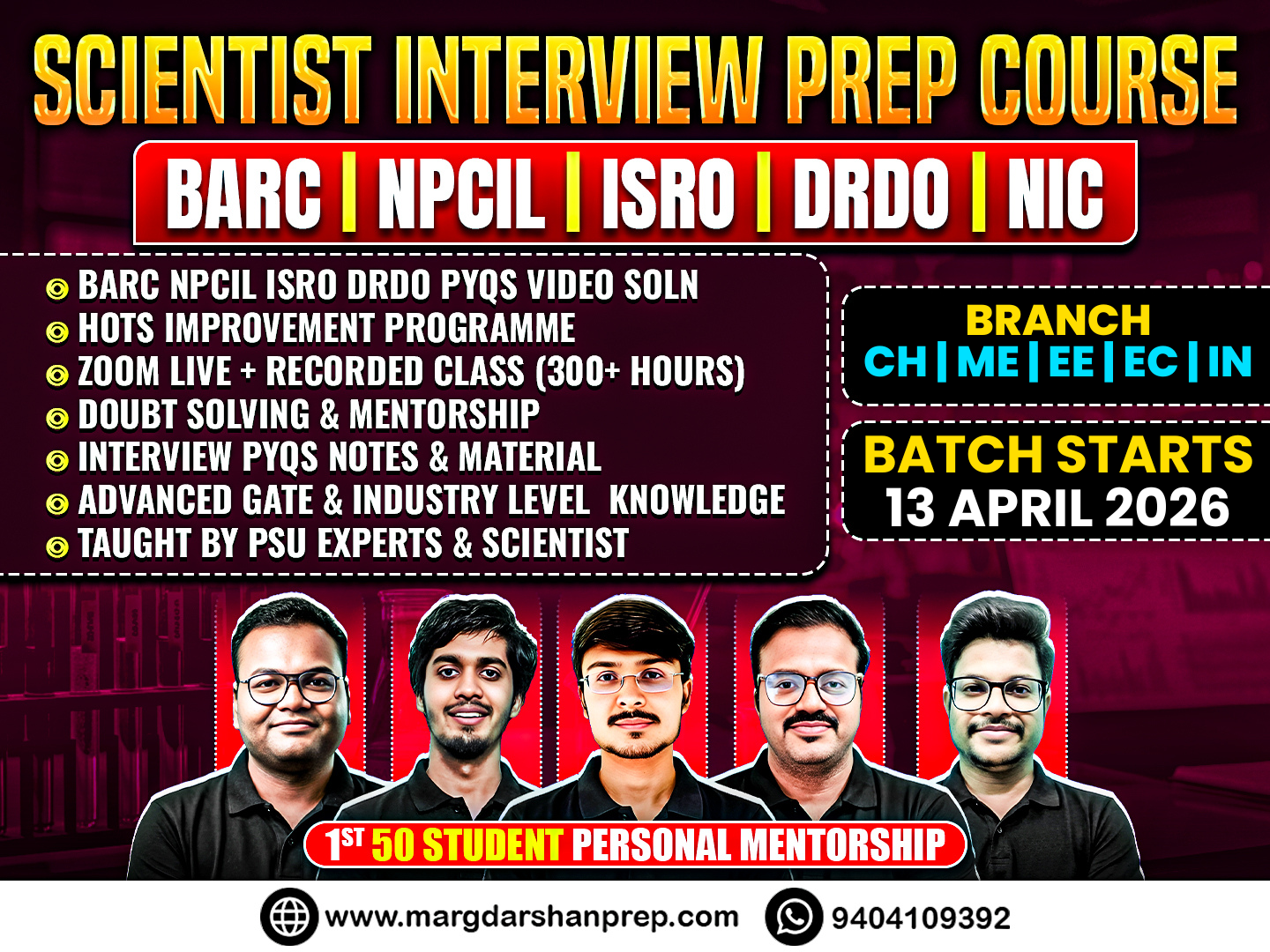
BARC Scientist Interview Preparation Course
If you are serious about selection, self-study alone is usually not enough.
👉 Enroll for BARC Interview Prep
What You Will Actually Gain
Real BARC-level mock interviews
Direct expert feedback
Focused revision of core subjects
Most expected interview questions
Clear improvement roadmap
Who Should Join?
BARC shortlisted candidates
GATE-qualified Electrical students
Anyone struggling with interviews
Final Words
BARC interview is not about covering everything.
It’s about:
Depth in basics
Clear explanation
Handling pressure
👉 These skills improve only with practice.
Start Your Preparation
The earlier you start, the better your chances.